Regulatory context
The bar is rising: Digital Work Systems legislation
NSW has passed the Work Health and Safety Amendment (Digital Work Systems) Act 2026 — for the first time in Australian law, employers carry a legal duty of care over how digital systems design and distribute work. The Act identifies four risk areas for any organisation using AI, automation or algorithmic management:
Workloads driven by algorithmic allocation
Unreasonable performance metrics and tracking
Excessive monitoring or surveillance of workers
Discriminatory decision-making in digital systems
The Act also contains a national harmonisation trigger — once Safe Work Australia moves on equivalent model laws, the Minister must review. Every state and territory should be watching NSW closely. Choosing workforce technology that keeps people informed, in control and treated fairly is now a compliance question, not just good practice.
Source: Dr Peta Chirgwin, GAICD — Chameleon Mettle Group, on Human Authority-Centred Work Design
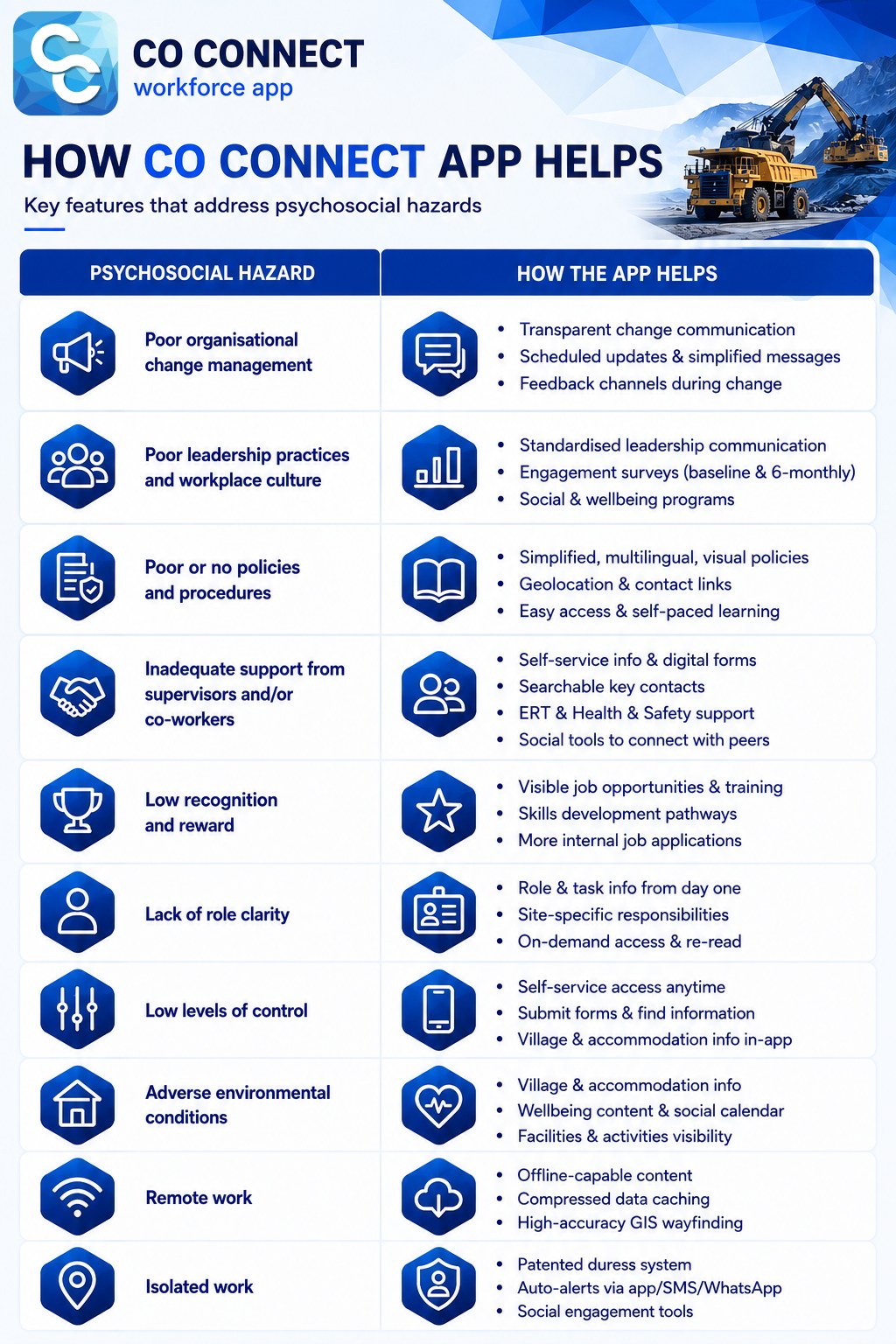
Poor organisational change management
Transparent, site-wide communication of organisational changes through the portal, with scheduled messages, simplified updates and offline-accessible content so every worker receives consistent information regardless of role or location. Feedback channels let workers raise questions and respond during periods of change, reducing uncertainty.
Poor leadership practices and workplace culture
Standardised communication from leadership gives all workers equal visibility of site information, reducing reliance on informal or inconsistent channels. Engagement surveys (baseline and six-monthly) give leaders data on worker sentiment, and social and wellbeing programming — quiz nights, walking clubs — supports a positive, connected culture beyond a bar environment.
Poor or no policies and procedures
Site policies, safety procedures and codes of conduct are accessible in simplified, multilingual, visual formats linked to geolocations and contacts. Workers can re-familiarise at their own pace, and the baseline workforce survey consults workers directly so content reflects real needs.
Inadequate support from supervisors and/or co-workers
Self-service access to information, contacts and digital forms reduces dependency on a single supervisor. Key contacts are searchable and linked, ERT and HSR feature-sets provide structured support pathways, and social tools help workers connect with peers across teams.
Low recognition and reward
Job opportunities, training and development pathways are visible to all workers, supporting skills development and utilisation. Improved visibility of internal vacancies drove a measurable increase in internal job applications, helping workers progress and feel valued.
Site-specific, simplified information about responsibilities, procedures and expectations is delivered automatically from day one via HR integration. Workers can access and re-read role and task information on demand, reducing confusion from changing or incompatible expectations.
Self-service access lets workers find information, submit forms and access contacts when and how they choose. Village and accommodation information is available in-app, giving workers more control and visibility over their non-work environment.
Adverse environmental conditions
Village and accommodation information, social and wellbeing calendars, and access to wellbeing content help workers manage rest, fatigue and comfort. Visibility of facilities and activities supports better management of life on site.
Offline-capable, compressed data caching and high-accuracy GIS wayfinding ensure critical information, communication and emergency tools remain available in low- or no-connectivity environments where resources are otherwise difficult to access.
The patent-pending duress system shares a worker’s name, number and location with emergency personnel, auto-dials the site emergency number and sends alerts via app, SMS and WhatsApp. Social engagement tools reduce isolation by connecting workers across teams and shared interests.
Inappropriate and unreasonable behaviour
Confidential, guided grievance reporting lets workers raise bullying, harassment, discrimination, racism or sexual harassment concerns with reduced fear of reprisal. Clear education on conduct standards supports Respect@Work compliance — particularly improving safety for women and contractors.
Traumatic events and materials
Dedicated ERT modules provide debriefing tools and structured call-out procedures for emergency responders exposed to traumatic events, alongside access to mental health and wellbeing resources for affected workers.
Consolidating multiple systems into one tool, with self-service access and streamlined digital forms, reduces the cognitive load and effort required to find information, report hazards and complete tasks.
GIS-enabled journey management and wayfinding reduce the stress and effort of navigating unfamiliar remote sites. Wellbeing content and visibility of rest and social activities support fatigue management, and digitised journey management replaces error-prone paper processes.
Alcohol and other drug use
Social and fitness programming — walking clubs, lawn bowls, games nights — intentionally creates connection opportunities beyond a bar or drinking environment, alongside access to wellbeing and mental health content.
The platform promotes sports, social and fitness events (with a measured increase in participation), provides wellbeing and mental health content, and surfaces health and safety information to support healthier behaviours on site.
Cross-site and multi-company functionality means contractors and transient workers stay connected and informed as they move between operations, arriving already familiar with the system. Equal access to information, opportunities and support reduces the disadvantage faced by insecure or contract workers.
Poor organisational justice
Making information, job opportunities, training and reporting pathways equally visible to all workers reduces the proximity bias that disadvantages remote or isolated workers, and helps prevent perceptions of unfairness or tokenism — supporting transparent and consistent treatment.